
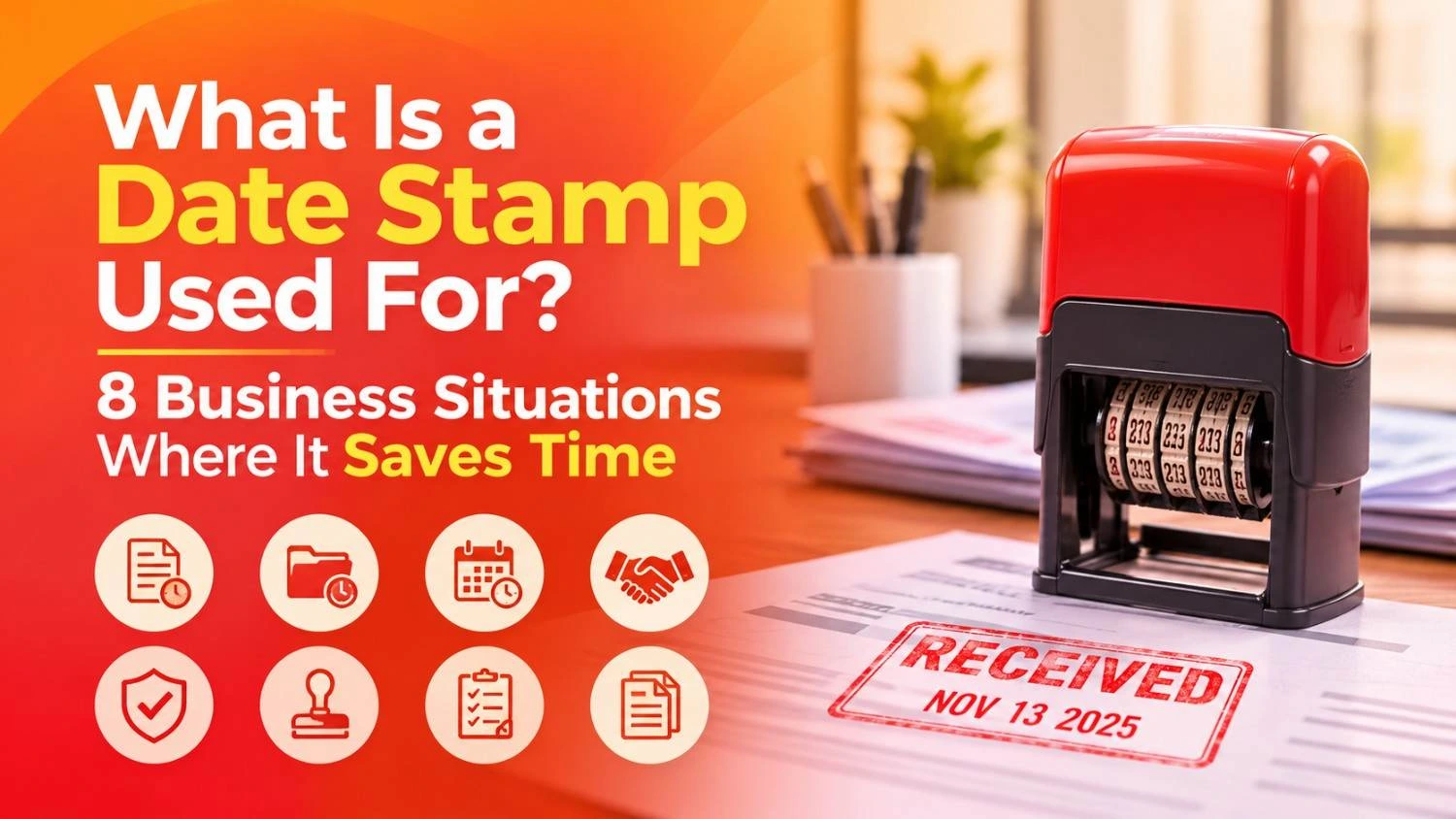
A date stamp is a hand-operated stamp that prints the current date, and sometimes the time, onto a document with a single press. Offices use it to record when a paper arrived, was approved, was paid or was filed. It replaces handwriting, which is slower and easier to misread. Across a busy week, that saved effort adds up. This article walks through eight everyday situations where a date stamp earns its place on the desk, then explains how to choose the right one.
How a Date Stamp Works
Most date stamps have adjustable bands or wheels for the day, month and year. You set the date, press the stamp on an ink pad or use a self-inking model, and the mark appears on the page. Time versions add hours and minutes, and some designs include fixed words such as received, paid or approved beside the date.
The real value is consistency. Everyone on the team produces the same format in the same place on the page, so records stay readable months later and anyone can find the key date at a glance.
8 Business Situations Where a Date Stamp Saves Time
1. Receiving Incoming Mail and Documents
Reception desks in Dubai and Sharjah offices handle invoices, letters, courier packages and contracts every day. Stamping each item on arrival creates a clear record of the receiving date. If a question later arises about when a document reached your company, the stamp answers it without searching through emails or logbooks.
2. Processing Invoices and Payment Vouchers
Accounts teams often stamp an invoice when it arrives, when it is approved and when it is paid. Three dates on one page show the status of a payment at a glance. This also helps staff keep track of supplier payment terms, such as 30-day or 60-day cycles.
3. Approving Purchase Orders and Requests
Procurement teams pass requests between several managers. A stamped date beside each signature shows when every approval happened. If a purchase order stalls, you can see exactly which desk it waited on.
4. Confirming Deliveries and Goods Received
Warehouses, shops and site offices sign for deliveries throughout the day. A date stamp on the delivery note records the day the goods came in, and a time stamp adds the hour when several deliveries arrive in batches. That detail is useful when you need to settle a supplier query about late or partial shipments.
5. Logging Client Visits and Service Jobs
Service centres, clinics and workshops often record when a customer arrived or when a job card was opened. Stamping the time on a sign-in sheet or job card gives staff a reliable reference if waiting times or turnaround come into question.
6. Archiving and Closing Files
Stamping the closing date on a completed file tells everyone when it left active use. When it is time to review old records, staff can sort folders by that date instead of opening each one.
7. Managing School and Institute Paperwork
Educational institutions handle admission forms, fee receipts, leave letters and certificate requests. A date stamp applied at the admin counter confirms when each paper was submitted. That matters when deadlines, such as admission cut-offs, decide whether an application is accepted.
8. Rotating Stock in Retail and Hospitality
Shops, cafés and hotel kitchens receive supplies that must be used in order. Stamping the delivery date on receipts and storeroom logs helps staff use older stock first. It also gives supervisors a quick way to check that deliveries match the day’s paperwork.
Date Stamp or Date and Time Stamp: Which Do You Need?
A plain date stamp is enough when only the day matters, such as for archived files or fee receipts. A date-and-time stamp is necessary when the hour affects the record, for instance, at reception desks, delivery bays or service counters. When choosing date and time stamps Dubai businesses rely on, start with one question: does the hour ever change how a document is judged?
Next, consider how the stamp will be used. A self-inking model has built-in ink, making it suitable for desks where staff stamp many pages quickly. A stamp that uses a separate ink pad works too, but the pad needs to be kept nearby and re-inked when the impression fades. Also, consider where the stamp will be placed, as a stamp shared across a counter should be easy for everyone to set correctly.
What to Check Before You Buy
Specifications vary, so ask the supplier rather than assuming. Reputable stamp makers in Dubai should be able to tell you the impression size, the date format, the ink options and whether the stamp can carry extra wording such as your department or a status word. Ask to see a sample impression if you can, because the size of the printed date affects how readable it is on crowded forms.
Date format deserves attention too. UAE businesses deal with local authorities, banks and international clients, so a clear day-month-year layout with the month shown in letters avoids confusion between formats such as 03/04 and 04/03.
Finally, match the stamp to the volume. A reception desk that stamps hundreds of pages weekly needs a comfortable grip and a reliable ink supply, while a small office that stamps a few invoices a day may be fine with a simpler model. If you need the stamp to carry a company name or approval wording, ask about a custom layout before ordering.
Common Mistakes to Avoid
The most frequent error is forgetting to reset the date. A stamp showing yesterday’s date on today’s invoice creates the very confusion it was meant to prevent. Make resetting the stamp the first task of the day, or assign one person to check it each morning.
Another mistake is stamping over printed text or signatures, which makes both unreadable. Leave a clear space on forms, or stamp in the margin. Faded ink is a third problem. If the impression looks pale, refresh the ink instead of pressing harder, which can smudge the date.
Lastly, remember what a date stamp cannot do. It records when something happened, but it does not replace a signature or an official company stamp. Use it alongside those, not instead of them.
Conclusion
A date stamp earns its keep in the small moments: a parcel signed for, an invoice approved, a form handed in before the deadline. Each stamped date removes a guess from your records and saves staff from hunting through emails or memory later. The right choice depends on whether you need only the date or the time as well, how many documents you stamp, and how readable the impression must be.
